DendamTak Sudah

Region: Negeri Sembilan, Federation of Malaysia

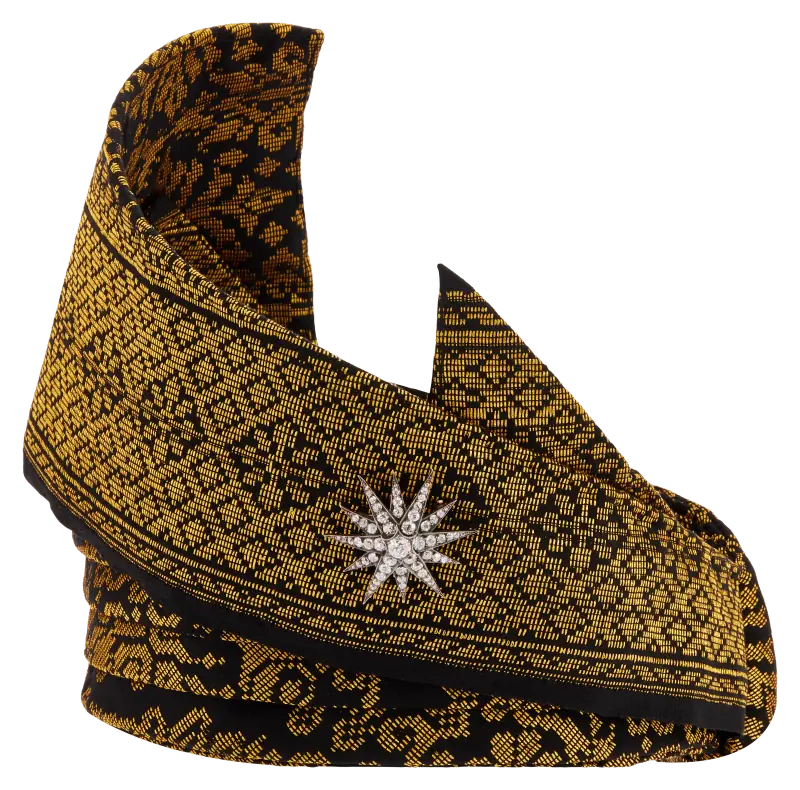
Dendam Tak Sudah tanjak folded from black songket with dense gold weft, rising to a single swept peak at the back, a silver star brooch pinned at the front.

The Everlasting Love

Dendam Tak Sudah is the official ceremonial headgear of His Royal Highness the Yang di-Pertuan Besar of Negeri Sembilan. The yellow-coloured version is reserved exclusively for the sovereign, while a variant in purple is designated for the Undang or Penghulu Luak—the traditional territorial chiefs of Negeri Sembilan. Upon Malaya’s independence in 1957, Dendam Tak Sudah was adopted as the official regalia of the Yang di-Pertuan Agong, the King of Malaysia. Despite its evocative name, Dendam Tak Sudah—literally, “Unending Vengeance”—should not be interpreted as a symbol of wrath. Rather, it represents unwavering commitment to justice, remembrance, and sacred duty. As royal regalia, it embodies a legacy of loyalty and the solemn burden of leadership passed through generations. The ceremonial context, symbolic structure, and embedded poetic language of Dendam Tak Sudah point to a deeper, more enduring meaning. When understood through the lens of cultural expression and artistic form, Dendam Tak Sudah is more truthfully and powerfully rendered as “Everlasting Love.”

Dendam Tak Sudah

The Everlasting Love

Dendam in classical Malay does not only mean revenge or grudge. In poetic and romantic literature (pantun, syair), it frequently conveys a deep emotional entanglement, such as longing, unresolved desire, or passionate memory (rindu dendam). Tak Sudah, meaning never-ending, can modify dendam into a timeless state of emotional intensity, not necessarily hostile or bitter. Thus, dendam tak sudah can be reframed as a phrase capturing the persistent, unresolved pull of love, akin to how rindu (longing) is never fully soothed.

The Dendam Tak Sudah tanjak is not merely a headpiece but a ceremonial crown woven with the metaphors of love and life. Each fold and curve is tied to stages of human intimacy and legacy. The tanjak encodes the lifelong, interwoven journey of love, union, and familial duty as part of a living, wearable poem.

Anatomical Parts of the Tanjak

Lambaian Kasih
Love’s Gesture / The Beckoning Fold
Puncak Kasih
Love’s Crest / Peak of Devotion
Gelembung Kasih
The Heart’s Swell / The Bloom of Love
Lipatan Kasih
Folded With Love / Layers of Devotion
Simpulan Kasih
Knot of Love / Binding of Hearts

Emotional and Relational Phases of Love

Kasih Berjawab
Love Returned / Love Answered
Kasih Bermula
Where Love Begins
Bertemu Kasih
Love Encountered / A Meeting of Hearts
Gelombang Kasih
The Surging of Love / Love’s Swell
Lambaian Kasih
Love’s Gentle Wave / Love Beckons

Courtship and Union

Langkah Bermula
The First Steps Taken
Risik Melangkah
Stepping with Intention / Courting Steps
Risik Bertemu
The Inquiring Union / Courting Fulfilled
Cincin Dikembang
The Ring Unfolds / Blossoming of the Bond
Lambai Kasih
Love Reaches Out / Love Extends Its Hand

If one interprets the Dendam Tak Sudah through its material semiotics, each layer—Lipatan Kasih (Folded with Love), Gelembung Kasih (The Heart’s Swell), Simpulan Kasih (Knot of Love), Puncak Kasih (Love’s Crest)—functions as a syntax of everlasting commitment. This turns the tanjak into a declaration of love that does not wane, even after death or duty. It is the visible form of a spiritual promise.
Dendam Tak Sudah

The Everlasting Love

Textile Description

This particular Dendam Tak Sudah is folded from a handwoven songket textile produced in Kuala Terengganu, made of cotton with supplementary gold weft (kencana) on a jet-black ground known as Hitam Jebat. The cloth is divided into three structural fields, each bearing layers of metaphor. The badan kain (main field) features the Teluk Berantai (chain-linked bays) pattern and a mirrored variation of Pucuk Rebung Lawi Ayam (bamboo shoot: rooster’s tail), woven alongside organic motifs such as Tampuk Manggis (mangosteen base), Buah Cermai (Malay gooseberry), Bunga Pecah Empat (four-petal flower), and Unduk-unduk Laut (seahorse). The patak/kepala kain (centre panel) displays Pucuk Rebung Berjuang (confronting bamboo shoots) and mirrored rooster-tail forms, accompanied by Bunga Bogan or Tiga Dara (bougainvillea or three sisters), Pucuk Rebung Lawi Ayam, and the stylized Kuih Potong Ladu (layered traditional sweets). At the kaki kain (border), motifs like Pagar Istana (palace palisade), Tampuk Kecupu (button calyx), and repeating Kuih Potong Ladu evoke enclosure, festivity, and grace.

Bearers

  • Yang di-Pertuan Agong (King of Malaysia)
  • Yang di-Pertuan Besar Negeri Sembilan

Note: The first Agong, Tuanku Abdul Rahman Ibni Tuanku Muhammad, wore a personalised version of Dendam Tak Sudah called Kacang Dua Helai Daun (Two-Leaf Bean), which had two shoots instead of one. It is said that the design was inspired by the flourishing twin leaves of a thriving bean plant (kacang), symbolising vitality, growth, and natural harmony. This tanjak was unique to Tuanku Abdul Rahman and was not continued by subsequent rulers, making it a rare and singular emblem of his reign.

RM 5,199

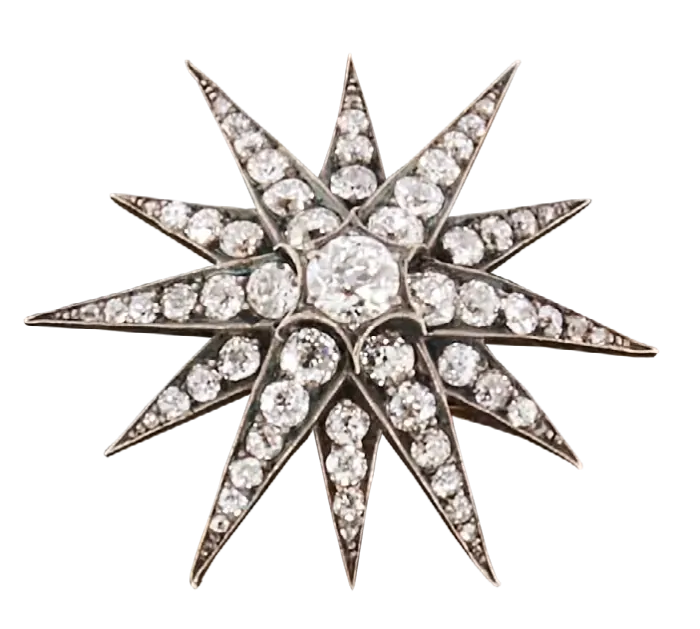
Keronsang Bintang, a silver star-shaped brooch with radiating points.

Keronsang Bintang

Late 19th century to mid 20th century

The bintang brooch is a versatile piece that can be worn by both men and women. It symbolizes wealth and status within the community, reflecting the Jawi Peranakans’ appreciation for detailed and symbolic ornamentation. The star shape, often associated with guidance and hope, adds a layer of cultural significance, making it not just a decorative item but also an emblem of cultural identity and pride.

(HARTA Museum Collection)

Not for sale