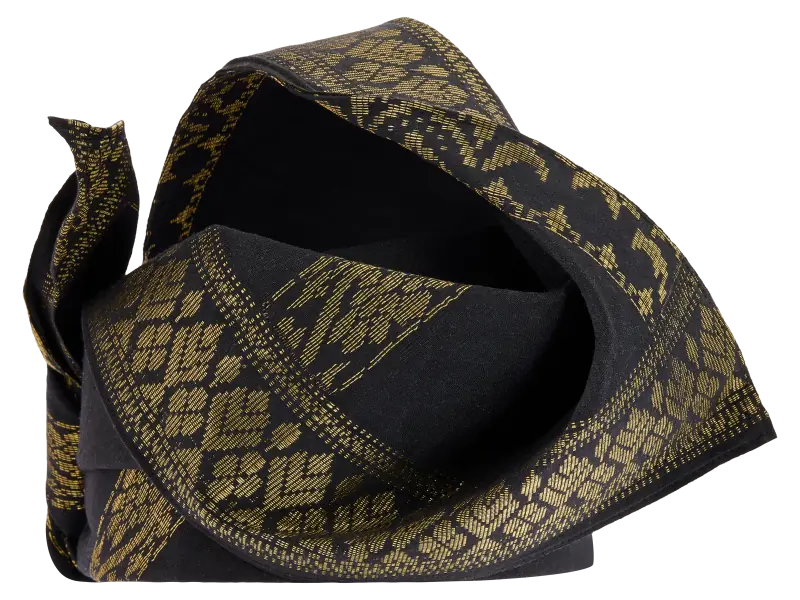
GajahGemulung

Region: Negeri Sembilan, Federation of Malaysia

Gajah Gemulung tanjak in black songket with gold patterning, its folds curled inward at the front.

Coiled-Tusked Elephant

Gajah Gemulung—“The Coiled-Tusked Elephant”—evokes wisdom, maturity, and legacy forged through age and service. The inwardly curled tusks symbolise strength honed over time and honour that endures beyond death. As a tanjak, it signified distinction and was reserved for figures of exceptional stature. In the Hikayat Hang Tuah, the famed Laksamana of the Malacca Sultanate is adorned in a “dastar bunga dikarang Gajah Gemulung”. It also appears in the Sejarah Melayu among royal ritual offerings of garlands, perfumes, and betel leaves.

“Maka Laksamana pun memakai dastar bunga dikarang gajah gemulung. Maka Hang Jebat, Hang Kasturi, Hang Lekir, Hang Lekiu pun sama-sama bertajuk bunga cempaka dan bunga angsoka dan bunga China.”

— Hikayat Hang Tuah (circa 1700) edited by Kassim Ahmad (1975)

This reference from Hikayat Hang Tuah describes the moment when the legendary Admiral (Laksamana) dons the dastar bunga dikarang Gajah Gemulung—a headgear evoking the nobility and grandeur of an ancient elephant with inward-curling tusks. The phrase encapsulates the visual and symbolic distinction of the Gajah Gemulung design: a crest worn by those of immense wisdom, stature, and lifelong service to the realm.

The metaphor of curled tusks refers to an elephant of great age, signifying enduring merit and legacy. In this context, the Gajah Gemulung was not merely an accessory, but a visual proclamation of authority, sacrifice, and remembrance—often worn by decorated warriors, nobles, and in this instance, the legendary Hang Tuah himself.

While Hang Tuah wore the Gajah Gemulung, his companions—Hang Jebat, Hang Kasturi, Hang Lekir, and Hang Lekiu—each adorned floral-themed headgear (bunga cempaka, bunga angsoka, and bunga China), reflecting their unique identities and roles in the Malay court.

Gajah Gemulung

Coiled-Tusked Elephant

“…bulang-bulang bunga dikarang; gajah gemuling (sic) berpuluh cepu; bau-bauan khelembak masak…”

— Sejarah Melayu (Sulalatus Salatin, 1808)

In the opulent ceremonial inventory described in the Sejarah Melayu, the Gajah Gemulung appears among lavish offerings of garlanded flowers, fragrant unguents, and finely wrapped betel leaf parcels. Mentioned alongside the most prized items of royal ritual—cempaka blossoms, scented waters, and khelembak (a form of musk)—the Gajah Gemulung is presented not as an isolated object but as a symbol of grandeur woven into the full spectrum of Malay regality. Referred to here in the plural (berpuluh cepu), these Gajah Gemulung were prepared en masse, likely as part of royal gift exchanges, investitures, or sacred rites. The term evokes the image of coiled-tusked elephants—beasts that, in Malay thought, symbolize majesty, age-old wisdom, and the longevity of sovereign power. As with other texts in the Malay world, this passage confirms the Gajah Gemulung as a recurring and prestigious form of headgear, recognized across courts as a mark of distinction.

“…sepegulungan muti emas akan belikan pada lehernya (Sikka: wuli), sayap sandang… dan gajah gemulung (biasa disandang oleh raja-raja)….”

— Hikayat Kerajaan Sikka (1925–1953)

This passage from Hikayat Kerajaan Sikka, a rare royal chronicle from eastern Indonesia, situates the Gajah Gemulung among an ensemble of court regalia reserved for kings. Described alongside gilded neckpieces (wuli), shoulder drapes (sayap sandang or mayang mengurai), and royal pendants, the Gajah Gemulung becomes a cross-cultural emblem of dynastic authority and sacred kingship. The phrase “gajah gemulung”, referring to a “coiled-tusked elephant,” alludes to majesty matured through age, echoing motifs found in Hikayat Hang Tuah. In the Sikka court tradition, the wearing of such a headpiece marked the bearer as one who carries the memory and gravitas of a long line of service and inheritance. Its inclusion in this list of regalia underscores its pan-archipelagic symbolism as a signifier of royal dignity, spiritual power, and historical continuity.

“…Maka diambil Indraputra bunga itu, ditaruhnya pada destarnya menjadi sedah dikarang gajah gemuling (sic)…”

— Hikayat Indera Putera (before 1700)

In this richly symbolic scene from Hikayat Indera Putera, the hero Indraputra encounters a magical flower that seeks him out and, upon receiving it, places it in his destar, which is described as “sedah dikarang gajah gemulung”—a crown woven in the form of the Gajah Gemulung. The imagery combines the mystical allure of nature with the iconography of royal majesty. Here, the Gajah Gemulung serves not merely as a physical headpiece but as a poetic metaphor of inherited nobility, valour, and divine favour. The coiled-tusk elephant motif—reserved for rulers and noble champions—marks Indraputra’s transformation into a destined hero, worthy of the reverence bestowed upon kings and warriors of the Malay world.

Not for sale